
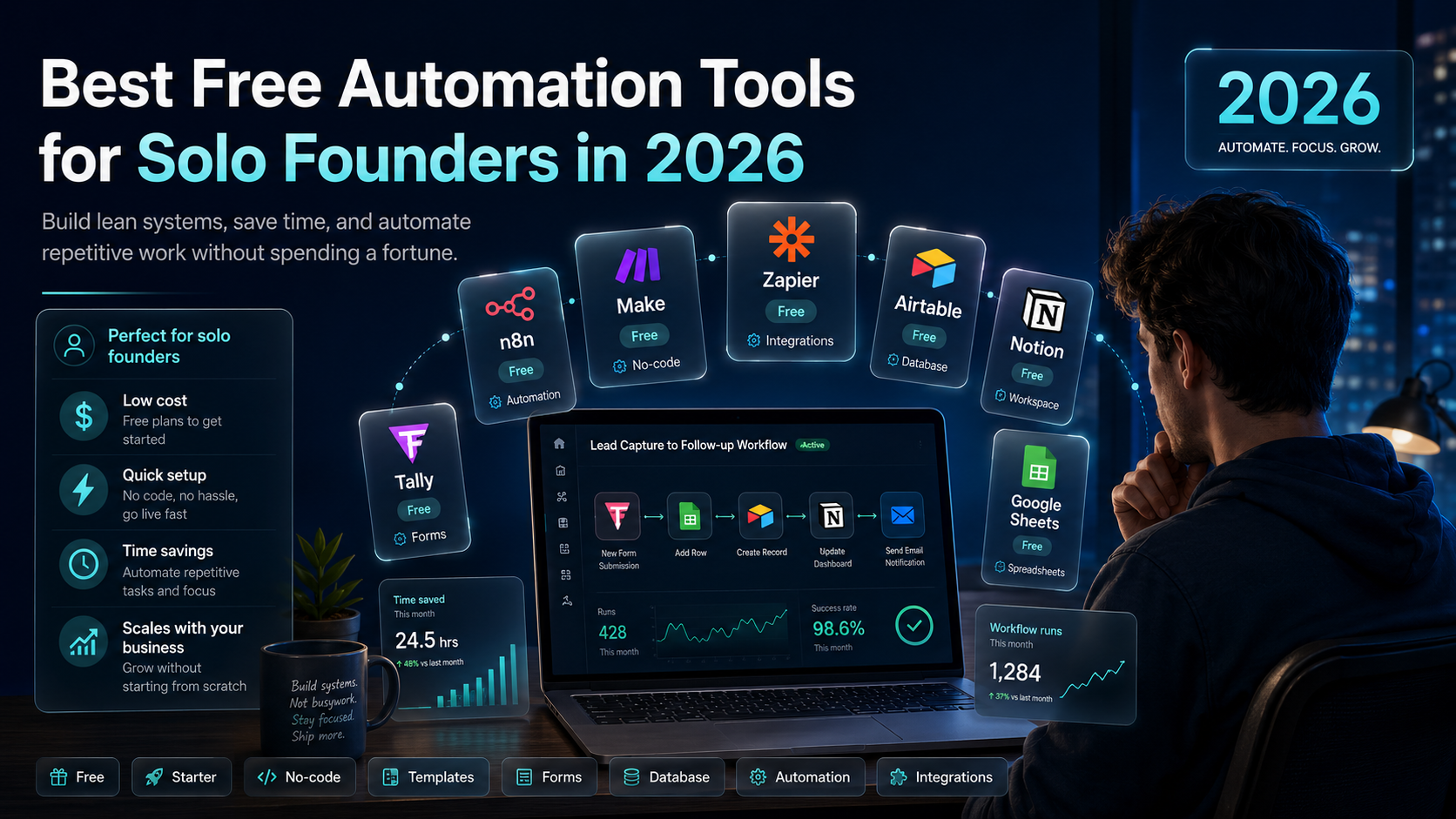
The best free automation tools for solo founders in 2026 — ranked by what their free tiers actually let you build — are Make.com (1,000 operations/month, multi-step, real webhooks), n8n self-hosted (unlimited everything on a $6 VPS), Pipedream (100 credits/day, code-friendly, 3 active workflows), Zapier Free (100 tasks/month, biggest app library but only 2-step Zaps), and HubSpot Free Workflows (basic CRM automation, generous contact limit). IFTTT is no longer competitive at 2 applets per free account. This guide shows what each one’s free tier actually unlocks, where it breaks, and which to pick first depending on your stack.
This is for solo founders, indie hackers, and one-person SaaS owners who want to automate lead capture, onboarding, content distribution, or operations without paying for an Ops Hub. The thesis is simple: most automation work a solo founder needs can run for free in 2026 — if you pick the right tool for the job and accept its specific tradeoffs.
Quick Answer: Which Free Tool to Pick First
For most solo founders, start with Make.com’s free plan — it offers the best ratio of capability to ease-of-use. You get 1,000 operations per month, unlimited active scenarios, multi-step workflows with routers and filters, and real webhooks. If you’re technical and already run a server, n8n self-hosted on a $6/month VPS gives you unlimited everything. If you’d rather write code than drag boxes, Pipedream is the right choice. Zapier Free is the fallback only if your tools are exclusively in Zapier’s app library and not in Make’s.
The 5 Best Free Automation Tools in 2026
1. Make.com Free — the obvious starting point
Free tier: 1,000 operations/month, unlimited active scenarios, 2 active scenarios at any time, 15-minute minimum scheduling interval, multi-step workflows, routers/filters/iterators, webhooks, ~2,000 integrations. Real cost: $0 if you stay under the cap.
Make’s free plan is what Zapier Free should have been. A single operation is one module execution, so a 5-step scenario that runs 200 times a month burns 1,000 ops — that’s about 6 lead routings per day or one daily KPI digest with lots of nodes. The UI is more powerful than Zapier’s (closer to a visual node editor) and the learning curve is slightly steeper. For most lead capture, content distribution, and CRM sync jobs a solo founder builds, this is the right tool. Our deeper notes on how Make compares to n8n in 2026 are worth reading before you commit.
2. n8n self-hosted — unlimited if you can run a VPS
Free tier: Unlimited workflows, unlimited executions, webhooks, code nodes (JavaScript/Python), 400+ integrations. Real cost: $6–10/month for a VPS (Hetzner CX22, Contabo, DigitalOcean basic droplet), plus a few hours of setup and ongoing maintenance time.
n8n is open-source and self-hostable via Docker — you run it on your own server, and there are no task counters, no operation limits, no premium-app gates. The cost is operational: you maintain the database backups, the SSL cert renewal, and the version updates. If you’re already comfortable with a Linux box and Docker Compose, this is the cheapest path to serious automation. n8n Cloud exists as a paid alternative ($24/month starting tier in 2026) if you’d rather not host it yourself, but self-host is the real value proposition.
3. Pipedream — code-friendly with a daily credit budget
Free tier: 100 credits/day, 3 active workflows, 3 connected accounts, 2M AI tokens/month, full code nodes (Node.js, Python, Go, Bash). Real cost: $0 if you stay under daily caps. Credits reset daily; unused credits do not roll over.
One Pipedream credit equals 30 seconds of compute time at 256MB memory — so most simple workflows cost one credit per execution. Development and testing are free (don’t consume credits), which is unusual and useful. The 3-workflow ceiling hurts; you’ll consolidate or migrate by workflow #4. Pipedream is ideal for solo founders who write code: it’s faster than learning Make’s visual editor and offers webhook handling, AI integrations, and arbitrary code execution that Zapier locks behind paid tiers. For getting started with webhook patterns generally, see our piece on what a webhook is and how to test one.
4. Zapier Free — the most apps, the harshest limits
Free tier: 100 tasks/month, 2-step Zaps only (1 trigger + 1 action), 15-minute polling, no premium apps, no webhooks, no filters/paths, no autoreplay. Real cost: $0, but you’ll outgrow it in weeks.
Zapier Free’s only real advantage is breadth — 9,000+ apps, including some that Make and n8n don’t have natively. The constraint to two-step Zaps is the killer for solo founders: you can’t filter (“only continue if lead value > $1,000”), you can’t transform (“convert UTC to local time”), and you can’t branch. If your stack is heavily Zapier-only, Free works as an evaluation tool for two weeks before you upgrade to Pro at $19.99/month with annual billing. Our piece on Zapier alternatives for marketers covers the migration angle in detail.
5. HubSpot Free Workflows — CRM-only but generous
Free tier: Unlimited contacts (up to 1M on HubSpot Free CRM), basic ticket and form follow-up automation, simple email sequences, no multi-step branching workflow builder (that’s Marketing Hub Starter at $20/month). Real cost: $0 if you stay inside HubSpot.
HubSpot’s free CRM tier includes basic automations: send a welcome email when a form is submitted, assign a contact to a stage based on a property, create a task when a deal moves. It’s narrow — only works inside the HubSpot ecosystem and doesn’t let you build cross-app workflows — but for solo founders running sales out of HubSpot, it removes the need to wire a separate automation platform for basic CRM tasks. For founders comparing CRMs to settle on, our roundup of the best CRM for small business in 2026 includes the HubSpot Free assessment in context.
Honourable mention: IFTTT — no longer business-grade
IFTTT’s free plan is capped at 2 Applets in 2026, with 60-minute polling. That’s enough for “ping me when it rains” personal automations, but unusable for any solo founder business workflow. The paid Pro plan at $2.99/month for 20 applets is cheap, but at that point Make’s free tier offers more capability. Skip IFTTT for business use.
Free Tier Comparison Table
| Tool | Free limit | Multi-step? | Webhooks? | Best for |
|---|---|---|---|---|
| Make.com | 1,000 ops/mo | Yes | Yes | Most solo founders |
| n8n self-hosted | Unlimited (+VPS $6/mo) | Yes | Yes | Technical founders |
| Pipedream | 100 credits/day, 3 workflows | Yes | Yes | Code-first founders |
| Zapier Free | 100 tasks/mo, 2-step | No | No | Biggest app library |
| HubSpot Workflows | Basic CRM automations | Limited | No (inside HS only) | HubSpot-native sales |
| IFTTT | 2 applets | No | Pro+ only | Personal/IoT only |
What Solo Founders Actually Build First
Lead capture to CRM
New lead from Typeform or a landing page form → create contact in HubSpot/Pipedrive → Slack notification to the founder. On Make Free this is ~3 operations per lead, so 1,000 ops covers 300 leads/month. On Zapier Free it’s 2 tasks but you can’t add filtering (e.g., skip spam, route by lead score) without upgrading.
Stripe payment to onboarding sequence
New Stripe checkout → generate invoice PDF → send welcome email → add to “active customer” list. Needs at least 4 steps, so Zapier Free can’t run it. Make Free handles it at ~5 operations per sale; at 100 sales/month, that’s 500 ops — half your monthly budget.
Daily KPI digest to Slack/email
Scheduled trigger 9am Monday → pull Google Analytics + Stripe + email-list stats → format as digest → post to Slack. ~10–15 operations per run, so on Make Free that’s ~50 runs/month possible — more than enough for daily. Zapier Free can’t pull from 3 sources without multi-step.
Content repurposing
New WordPress post → AI generates LinkedIn post + X thread → schedule in Buffer. ~6 operations on Make Free, plus OpenAI API costs (about $0.01–0.03 per article). 1,000 ops = 160 articles, way more than any solo founder publishes.
What None of These Handle Well on Free
High-volume e-commerce. A Shopify store with 100+ orders/day will exceed every free tier within days. Either pay for Make Core ($10.59/month) or move to native Shopify Flow.
Real-time SLAs under 5 minutes. All free tiers have minimum scheduling intervals of 15 minutes for polling, and most non-instant triggers add latency. If you need sub-minute reactions, you need real webhooks plus a paid plan or self-hosted n8n.
Niche regional or custom SaaS. If your stack relies on a Ukrainian-only CRM, a regional payment processor, or a custom in-house tool without a native integration, you’ll need webhook handling and custom HTTP modules. Make Free has these; Zapier Free doesn’t. Pabbly Connect is a paid alternative worth knowing — see our Pabbly Connect review for 2026 for context.
Long-running data pipelines. ETL-style work that processes thousands of records on a schedule will exhaust free tiers fast. For these jobs, write a script and run it on a cheap VPS instead. Our roundup of no-code API tools and Postman alternatives covers what pairs well with custom scripts.
Decision Framework: Pick Your Tool in 60 Seconds
Pick Make.com Free if you’re non-technical or only mildly technical, you want a no-code drag-and-drop UI, and you’ll run fewer than 1,000 operations/month. This is the default recommendation for ~70% of solo founders.
Pick n8n self-hosted if you already pay for a VPS, you’re comfortable with Docker Compose, and you want to keep operational costs flat as you scale. The setup takes 1–2 hours; ongoing maintenance is ~30 minutes per month.
Pick Pipedream if you prefer writing code over wiring boxes, you have 3 or fewer core workflows, and your usage stays under 100 credits/day (most workflows are 1 credit each). Pipedream’s testing-is-free policy makes it especially good for iteration-heavy builds.
Pick Zapier Free if the apps you absolutely need only have Zapier integrations, and you accept that you’ll upgrade within 2 weeks. Use it as a validation tool, not a production tool.
Pick HubSpot Workflows if your stack is HubSpot-centric and you only need CRM-internal automations. Don’t try to wire it to non-HubSpot tools on Free — that’s what Marketing Hub Starter ($20/month) is for.
Conclusion
The honest answer for most solo founders in 2026 is: Make.com’s free plan is enough. 1,000 operations covers the common workflows — lead capture, payment onboarding, KPI digests, content repurposing — without forcing you to pay. If you’re technical and run a VPS, n8n self-hosted gives you a moat: as your workflows multiply, you don’t pay more. Pipedream is the developer’s pick, Zapier Free is the fallback when nothing else integrates with your tools, and HubSpot’s built-in automations cover the CRM corner. Skip IFTTT for business. Start with one free tool this week, build one workflow that saves you 30 minutes, then add a second next week. By month three you’ll know whether you’ve outgrown the free tier — and which paid tier makes sense.
FAQ
What is the best free automation tool for a solo founder in 2026?
For most solo founders, Make.com’s free plan is the best starting point — 1,000 operations per month, multi-step workflows, real webhooks, and unlimited scenarios. If you’re technical and already run a VPS, n8n self-hosted offers unlimited everything for the price of the VPS (around $6/month).
Is Zapier free worth it for solo founders?
Only as a validation tool. Zapier Free’s 100-task and two-step limits make it impractical for production workflows. Use it for 1–2 weeks to confirm the automation idea works, then either upgrade to Zapier Pro at $19.99/month with annual billing or migrate to Make.com’s free tier, which offers ~10× the capacity.
Can I really run a business on n8n self-hosted?
Yes — and many solo founders do. The trade-off is operational: you maintain the server, database backups, and version updates. Budget around 30 minutes per month of maintenance. The upside is unlimited workflows and executions at fixed VPS cost, which scales better than per-task pricing as your usage grows.
What’s the catch with Pipedream’s free plan?
The 100-credit-per-day limit (not per month) and the 3-active-workflow ceiling. Unused daily credits don’t roll over. If you build a 4th workflow, you’ll need to consolidate or upgrade. Testing and development are free of credits, which softens the constraint.
Do free automation tools support webhooks?
Make.com Free, n8n self-hosted, and Pipedream all include webhooks on their free tiers. Zapier Free does not — webhooks are a premium app locked to Pro. IFTTT only adds webhooks at the Pro+ tier ($8.99/month).
When should a solo founder pay for automation?
When automation is saving you more than 4 hours per month and the free tier holds you back from adding the next workflow. At a $50/hour personal rate, that’s $200/month saved against a $10–30/month paid plan. Anything below that, free is fine.