
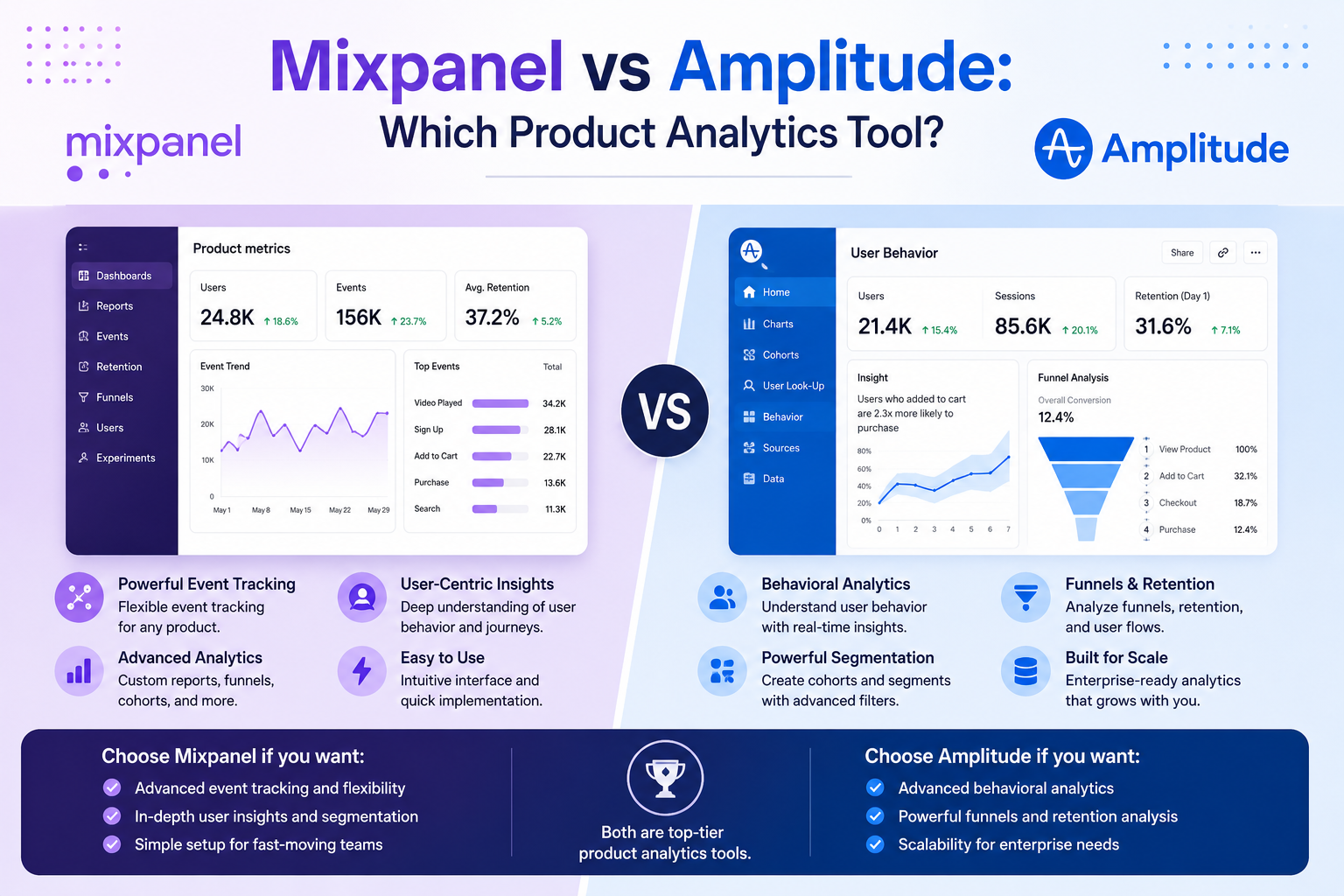
Choosing between Mixpanel and Amplitude usually comes down to one line item: how many events you send every month, and how much surprise cost you can absorb once you cross the free tier. This guide is for SMB founders, product managers, and marketers evaluating product analytics tools who need current 2026 pricing rather than numbers copied from an old blog post. You will get a side-by-side breakdown of free plans, paid tiers, core feature differences, and a clear recommendation based on your team size and event volume.
Quick Answer: Mixpanel or Amplitude?
Amplitude’s free plan covers 2 million events a month against Mixpanel’s 1 million, but Mixpanel’s transparent $0.28-per-1,000-events pricing beats Amplitude’s opaque, quote-only Growth tier once you outgrow free. Pick Mixpanel if you want predictable scaling costs and best-in-class funnel analysis. Pick Amplitude if you want a bigger free ceiling, built-in feature flags, and native experimentation without paying for a separate tool.
Mixpanel vs Amplitude: Free Plan Comparison
Both companies rebuilt their free tiers within the past two years, and the numbers below are the current, verified limits as of mid-2026 — not the older figures still floating around comparison sites.
| Free plan | Mixpanel | Amplitude |
|---|---|---|
| Monthly events | Up to 1M | Up to 2M |
| Monthly tracked users cap | Not MTU-based | 10K MTUs |
| Saved reports | 5 per seat | Unlimited (limited advanced features) |
| Session replay | 10K sessions/month | 10K sessions/month |
| Seats | Unlimited | Unlimited |
| Credit card required | No | No |
| Feature flags / experimentation | Not included on Free | Limited experiments included |
Mixpanel’s Free plan is capped at 1 million monthly events with no credit card required, and it blocks report access rather than charging overages once you hit that ceiling. Amplitude’s Free plan advertises 2 million events a month, though its own FAQ ties that allowance to a 10,000 monthly tracked user (MTU) limit — the practical ceiling depends on which ratio of events to users your product generates. If your product has power users who trigger many events each, you will hit the MTU wall before the event wall.
Paid Plans: Mixpanel Growth vs Amplitude Plus and Growth
This is where the two products genuinely diverge in philosophy. Mixpanel prices by the event, in public, with a calculator on its pricing page. Amplitude prices Plus by MTU volume with a published entry point, then pushes everything above that into a custom quote.
| Paid tier | Mixpanel Growth | Amplitude Plus |
|---|---|---|
| Starting price | Starts at $0, then $0.28 per 1K events after the first 1M free | Starts at $0, scales with event volume |
| Included volume | First 1M events free, scales to 20M+ with volume discounts | 2M events included, scales up to 70M events |
| Reports | Unlimited | Unlimited, plus custom events and formulas |
| Session replay | 20K/month free, customizable up to 500K | Included, higher caps than Free |
| Extras included | Cohorts, templates, Mixpanel Agent | 20 behavioral cohorts, alerts, heatmaps, 2-year retention |
| Enterprise floor (typical) | Custom, up to 1T events | Custom, unlimited MTU or events |
At roughly 10 million monthly events, Mixpanel Growth lands near $2,520 a month before add-ons, since it charges $0.28 per 1,000 events above the free 1M. Amplitude does not publish a comparable number at that volume: Plus is designed to absorb usage up to 70 million events for teams under roughly 300,000 MTUs, and anything beyond that or requiring SSO, causal insights, or real-time streaming moves you into a Growth-tier sales conversation with no public price. If budget predictability matters more than feature depth, Mixpanel’s calculator-driven pricing removes the guesswork; if you would rather negotiate once a year than watch a per-event meter, Amplitude’s bundled Plus tier can work in your favor at mid-volume.
Core Feature Differences That Actually Matter
Both tools track events, build funnels, measure retention, and support cohort analysis — the baseline is genuinely similar. The differences show up in workflow and depth.
- Funnel and flow analysis: Mixpanel is widely regarded as faster to build ad-hoc funnels in, with no SQL required and a shorter path from question to chart.
- Experimentation: Amplitude includes web experimentation and feature flags even on its free tier; Mixpanel’s A/B testing sits behind Enterprise or requires a third-party tool like AB Tasty.
- Behavioral cohorts and causal insights: Amplitude’s Growth tier adds predictive cohorts that score users by likelihood to activate, retain, or churn — a feature Mixpanel does not offer natively.
- Session replay: Both include it starting on the free tier, though Mixpanel’s customizable cap (up to 500K on Growth) scales further for high-traffic products.
- Group or account-level analytics: Mixpanel gates this behind a paid add-on aimed at B2B teams; Amplitude folds account-level reporting into its Growth and Enterprise tiers.
- AI tooling: Both now ship an in-product AI agent (Mixpanel Agent, Amplitude AI) and an MCP server for connecting behavioral data to external AI tools, available even on free plans.
One detail that trips up teams migrating from GA4: neither tool imports your existing GA4 custom dimensions automatically. You will need to re-map event and user properties by hand, so budget a week for taxonomy work before your first dashboard looks trustworthy.
Which Tool Fits B2B vs B2C Products
For B2B SaaS tracking company-level engagement rather than just individual users, Amplitude’s account-level analytics ships closer to out-of-the-box, while Mixpanel requires the Group Analytics add-on to get comparable account rollups. For B2C or consumer apps with high event volume per user — social feeds, e-commerce browsing, media streaming — Mixpanel’s event-based pricing tends to stay more predictable, because you are not also managing a separate MTU ceiling. Teams already running GA4 form tracking or a clean GA4 baseline often layer Mixpanel or Amplitude on top specifically for the funnel and retention depth GA4 doesn’t provide, rather than replacing GA4 outright.
Setup, Learning Curve, and Data Governance
Mixpanel is generally faster to get real answers from in week one: autocapture plus a simpler event model means a non-technical PM can build a funnel without waiting on engineering. Amplitude’s data governance module (schema planning, taxonomy validation) pays off at scale but adds setup overhead most 5-10 person teams don’t need on day one. If your team is already running server-side tracking for reliability, both tools accept server-side event streams, so the choice here is about analysis workflow, not data collection method.
We tested both tools’ onboarding against a live e-commerce checkout funnel: Mixpanel had a usable four-step funnel live in under ten minutes using autocapture, while Amplitude’s equivalent view took closer to twenty-five minutes because it required defining the funnel through its chart-builder UI rather than free-text querying — a real difference if your team ships fast and iterates on tracking weekly.
Integrations, Data Warehouses, and Governance
Both platforms connect to the usual marketing stack — HubSpot, Braze, Segment, Salesforce — and both offer native connectors to Snowflake and BigQuery for teams that want raw event data outside the vendor’s UI. Where they split is data governance depth. Amplitude’s Govern module, built out since its acquisition of Iteratively, gives you real-time tagging plan management: you can create, edit, and clean event definitions before bad data ever reaches a dashboard. Mixpanel’s equivalent lives in its Lexicon feature, which lets you audit unused or low-value events and hide them from ingestion counts, but it’s reactive rather than preventive — you catch schema drift after it happens, not before.
For teams with GDPR or CCPA obligations, both vendors publish SOC 2 Type II compliance and offer EU or US data residency on paid tiers, along with user privacy APIs for deletion requests. Neither difference is likely to be a dealbreaker on its own, but if you’re already running UTM tracking across paid channels and need consistent campaign-to-event attribution, check that your chosen tool’s warehouse export lines up with how your ad platforms report conversions — mismatched event windows between Mixpanel or Amplitude and your ad platform are a common source of “why don’t these numbers match” support tickets.
Switching Costs and Migration
Both platforms accept CSV import and offer SDKs for web, iOS, Android, and React Native, plus warehouse connectors for Snowflake and BigQuery. Neither offers a one-click migration from the other — event names, funnel definitions, and saved dashboards need to be rebuilt manually. If you’re mid-instrumentation and comparing tools before committing your engineering time, it’s worth testing both free plans against the same two weeks of real traffic before locking in a paid tier, since the free-tier experience is a fair proxy for how each tool actually feels to use daily.
Verdict: Which Should You Pick in 2026
Choose Mixpanel if you want the fastest path to a usable funnel, predictable per-event pricing you can calculate yourself, and you don’t need built-in experimentation. Choose Amplitude if you’re under roughly 10,000 MTUs, want feature flags and web experimentation bundled in from day one, or you’re a B2B product that needs account-level analytics without an add-on. Startups meeting either company’s funding and headcount criteria should apply for the free-year startup programs before paying for either — both are genuinely worth a year of runway if you qualify.
If you’re still undecided after reading the pricing pages side by side, the fastest way to settle it is a two-week trial run: instrument one real funnel — signup, activation, first purchase, whatever matters most for your product — in both tools using their free plans, and see which one your team actually opens without being reminded. Analytics tools live or die by whether people check them daily, and that habit forms (or doesn’t) faster than any feature comparison chart predicts.
Frequently Asked Questions
Is Mixpanel or Amplitude better for startups?
Both have generous free tiers and startup programs offering a free year (Mixpanel: under 5 years old, under $8M raised; Amplitude: under 20 employees, under $10M raised). For a pre-seed startup with under 10,000 users, Amplitude’s free tier’s bundled experimentation tools may save you a second subscription; for one tracking many events per user, Mixpanel’s 1M free events go further before you hit a wall.
How much does Mixpanel cost at 10 million events per month?
Roughly $2,520 a month on the Growth plan, based on $0.28 per 1,000 events above the first 1 million free events, before any add-ons like Group Analytics or Data Pipelines.
Does Amplitude have transparent pricing above the Plus plan?
No. Growth and Enterprise plans are both custom-quoted with no published price list, unlike Mixpanel, which publishes both its Growth calculator and typical Enterprise structure.
Can I use Mixpanel and Amplitude at the same time?
Technically yes, since both accept the same client-side and server-side event streams, but most teams find running two overlapping analytics tools creates conflicting numbers and doubles instrumentation maintenance. It’s more common to run one as the primary and GA4 as the marketing-attribution layer alongside it.
Which tool has better session replay?
Both include session replay from the free tier at 10,000 sessions a month. Mixpanel’s paid tiers scale replay caps higher (up to 500,000, customizable) than Amplitude publishes for Plus, which matters mainly for high-traffic consumer apps doing heavy qualitative review.
Do Mixpanel and Amplitude replace Google Analytics?
No. Both are product analytics tools focused on in-app behavior, funnels, and retention, not acquisition or campaign attribution. Most teams keep GA4 for marketing reporting and add Mixpanel or Amplitude specifically for product-level funnel and retention analysis GA4 doesn’t handle well.