
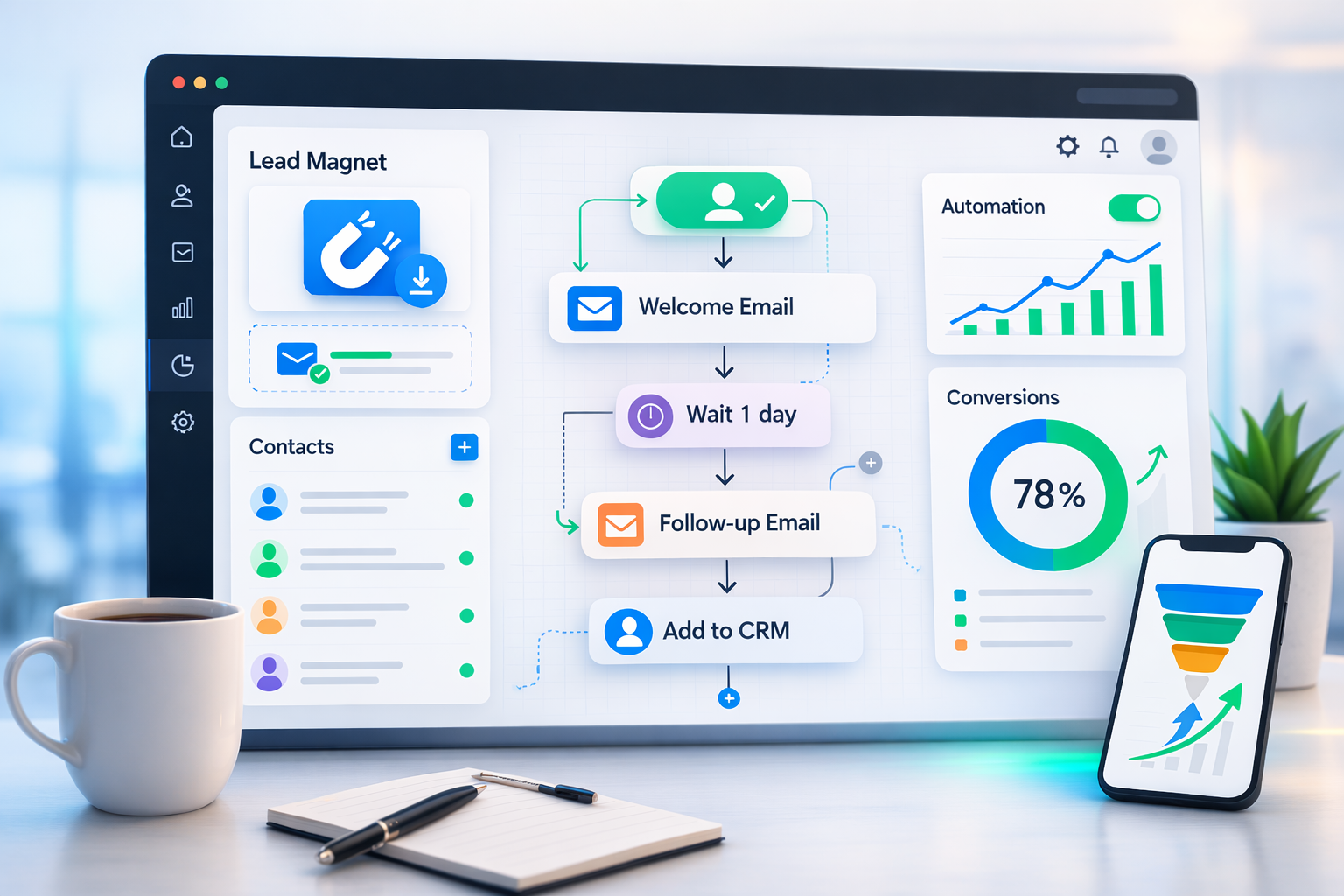
Updated: 2026. Lead magnets and automated funnels still work, but not in the old “download a PDF and hope for sales” format. Today, SMB owners and marketers need a simple system: a clear offer, fast value, a lead capture form, a structured follow-up sequence, and one logical next step — a call, demo, quote request, consultation, or purchase. In this article, you will find a practical framework for building a lead magnet and an automated funnel without fluff: what to offer, how to structure the user journey, which metrics matter, and where businesses usually lose leads.
This guide is useful for small and mid-sized businesses selling services, SaaS, consulting, training, B2B solutions, or higher-consideration products. The logic is universal: give people a useful first step, capture the contact, segment intent, and move them toward the next action automatically.
Table of contents
- What a lead magnet and automated funnel actually are
- Why this model works in 2026
- What makes a strong lead magnet
- Example of an automated funnel structure
- Lead magnet formats that work best
- Landing page structure for lead capture
- What should happen after the signup
- Table: funnel stage checklist
- Which KPIs to track
- What tools you actually need
- Common mistakes
- How to launch in 7 days
- FAQ
What a lead magnet and automated funnel actually are
A lead magnet is a specific piece of value that a prospect receives in exchange for contact information or another conversion action. It can be a checklist, template, short audit, calculator, mini-course, webinar replay, demo access, framework, or practical example. The best lead magnets solve a small but real problem immediately.
An automated funnel is the sequence that happens after the lead is captured. It usually includes a landing page, form, thank-you page, email or messenger follow-up, segmentation logic, retargeting, and a handoff to sales when the lead shows meaningful intent. The goal is not to replace sales, but to warm up the lead and move them toward the next step in a structured way.
The core principle is simple: do not ask for too much too early. First, reduce uncertainty. Show relevance. Deliver value. Build trust. Then invite the prospect into a more committed action. For SMB teams, this matters because traffic is expensive, attention is fragmented, and many leads are lost simply because there is no follow-up system in place.
Why this model works in 2026
In 2026, buyers expect value before a sales conversation. They compare vendors, read reviews, watch short explainers, check case studies, and try to understand whether your solution is relevant before they talk to anyone. That is why a modern lead magnet should do more than “collect an email.” It should lower friction, clarify the problem, and show a useful path forward.
Another reason this works is that customer journeys are now multi-touch and multi-device. A person may discover your brand through search, click an ad on mobile, open an email later on desktop, visit your pricing page from a retargeting ad, and only then book a call. Without an automated funnel, these micro-moments stay disconnected, and conversion rates suffer.
For SMB companies, this is good news. You do not always need a bigger ad budget to get better results. In many cases, you need a better system that turns existing traffic into qualified conversations. A clear lead magnet and follow-up flow can improve conversion without increasing spend.
What makes a strong lead magnet
A strong lead magnet does not need to be long. It needs to be relevant, easy to consume, and closely connected to your paid offer. Prospects should instantly understand three things: what they get, how quickly they can use it, and why it is worth claiming now.
1. One problem, one result
Do not try to compress your entire expertise into one asset. Narrow wins. “CRM launch checklist for SMB,” “sales pipeline template,” “ROI calculator,” or “5-point ad account audit” usually convert better than broad guides. Specific offers feel more actionable and more credible.
2. Fast value
Your lead magnet should create a quick win. A short template, benchmark checklist, worksheet, or practical mini-audit often outperforms a long PDF that people save and never read. The faster the prospect can use it, the stronger the trust signal becomes.
3. A natural bridge to your core offer
The lead magnet should naturally lead into the service or product you sell. If you offer CRM implementation, a field map template or a pipeline audit makes sense. If you provide paid media services, a tracking checklist, campaign structure template, or UTM framework is a better fit. When the lead magnet and the paid offer are aligned, the funnel feels helpful rather than pushy.
Example of an automated funnel structure
Below is a simple structure that works for many SMB companies. It is not overly complex, but it is enough to create movement from traffic to lead to qualified conversation.
- Step 1. Traffic source. Search, paid ads, social content, partner posts, webinars, YouTube, newsletters, or organic content.
- Step 2. Landing page. One offer, one conversion goal, minimal distractions.
- Step 3. Form. Capture only the fields you need. Cold traffic usually converts better with less friction.
- Step 4. Thank-you page. Deliver the asset and present the next logical step immediately.
- Step 5. Follow-up sequence. A short series of emails or messages that adds context, proof, and urgency.
- Step 6. Segmentation. Clicks, replies, page visits, quiz answers, or CTA actions signal different intent levels.
- Step 7. Sales handoff. Sales speaks to the warmest leads with full context.
- Step 8. Retargeting. Bring back people who claimed the lead magnet but did not move forward.
The power of the funnel is in the sequence, not the number of steps. Each touchpoint should answer the next buyer question: What do I do next? Why does this matter? Why should I trust this company? What happens if I delay?
Lead magnet formats that work best
Choose the format based on usefulness and buying context, not trends. In 2026, the following formats still work well for SMB:
- Checklist. Great for launches, audits, readiness assessments, and process reviews.
- Template. Ideal for briefs, scripts, workflows, spreadsheets, email drafts, or planning documents.
- Calculator or quiz. Useful for personalizing outcomes and segmenting leads by intent.
- Mini-audit. Strong for services, consulting, B2B, and high-consideration offers.
- Case study bundle. Helpful when prospects want proof and real-world examples.
- Video lesson or short email course. Good when the product needs explanation.
- Demo access or guided walkthrough. Effective for SaaS and digital tools.
The strongest lead magnets create momentum. Instead of offering “an ebook about marketing,” offer a practical “tracking checklist before launching ads.” Instead of “a CRM guide,” offer “a ready-to-use CRM field map template.” Specificity usually wins.
Landing page structure for lead capture
Many funnels fail before automation even starts because the landing page is too vague, too busy, or too hard to act on. A working lead capture page usually includes the following elements:
- Hero section: a clear headline, concise subheadline, a short value list, and a visible form or CTA.
- What is included: show what the prospect gets, in what format, and how quickly they can use it.
- Who it is for: owners, marketers, sales managers, SaaS teams, service businesses, or niche-specific audiences.
- Outcome: less chaos, faster setup, better conversion, cleaner reporting, lower waste, or stronger sales readiness.
- Proof: case references, realistic result examples, testimonials, or selected client examples when appropriate.
- Objection handling: a short FAQ section can remove hesitation before the form.
- Final CTA: repeat the form or button at the bottom of the page.
Keep the form short, especially for cold traffic. Name and email may be enough. If your sales process requires more detail, collect it after the opt-in through a short quiz, thank-you page CTA, or reply-based follow-up. That approach usually protects conversion rate better than adding too many fields upfront.
What should happen after the signup
The thank-you message should not be the end of the journey. It should direct the next action. Here is a simple post-signup sequence that works in many industries.
- Day 0: deliver the lead magnet and explain how to use it.
- Day 1: highlight one common mistake people make around this problem.
- Day 2 or 3: show a case example or before/after scenario.
- Day 4: address a key objection such as timing, complexity, internal resources, or budget readiness.
- Day 5 or 6: offer a soft CTA such as a demo, audit, consultation, or strategy call.
- Day 7+: move engaged leads into a warmer segment and use retargeting or a separate branch.
Each message should stand on its own and still be useful even if the prospect does not buy immediately. That is what makes follow-up feel relevant rather than annoying. In practice, helpful sequences outperform overly aggressive sales-only sequences.
Table: funnel stage checklist
| Stage | What should be in place | Main goal | Key metric |
|---|---|---|---|
| Traffic | Relevant message matched to audience and channel | Attract qualified clicks | CTR, CPC, traffic quality |
| Landing page | One offer, clear benefits, short form | Convert visitor into lead | Landing page conversion rate |
| Lead magnet | Fast value and practical outcome | Build trust | Download or open rate |
| Thank-you page | Immediate next step such as quiz, demo, case, or call | Increase intent | CTR to next action |
| Follow-up sequence | 3–7 touches: value, proof, objections, CTA | Warm the lead | Open rate, CTR, reply rate |
| Segmentation | Tags, events, behavioral signals | Identify warm leads | MQL rate, SQL rate |
| Sales | Fast response with full lead context | Move to call or deal | Show-up rate, close rate |
Which KPIs to track
Many teams focus only on lead volume. That is not enough. To understand whether your lead magnet and funnel are actually working, measure the full path:
- landing page conversion rate;
- cost per lead by channel;
- lead magnet open or download rate;
- CTR from the thank-you page to the next step;
- email or messenger open rate, click rate, and reply rate;
- MQL and SQL rate if you use CRM qualification stages;
- show-up rate for calls or demos;
- sales conversion and average time to close.
The most useful question is not “Did we get leads?” but “Where did the funnel lose momentum?” Sometimes the issue is the offer. Sometimes the landing page converts well, but the follow-up adds no trust. Sometimes marketing brings decent leads, but sales gets no context and follows up too late.
What tools you actually need
You do not need a huge marketing stack to launch this. At a minimum, you need a website or landing page builder, a form tool, an automation platform for email or messaging, and a CRM or at least a structured lead tracking sheet. From there, you can add analytics, retargeting, event tracking, segmentation, scoring, and reporting.
In practice, many SMB setups look like this: WordPress or a landing page tool, a connected form, an email or messenger automation platform, a CRM for lead routing and status updates, and analytics to preserve source and campaign data. The important part is not the number of tools. It is whether they pass context properly: source, campaign, page, lead magnet type, CTA click, and engagement signals.
Common mistakes
- The offer is too generic. “Free guide for business” is weaker than a focused practical asset.
- The form is too long. Too much friction kills cold-traffic conversion.
- No next step after opt-in. The lead gets the asset but is not guided anywhere.
- The sequence is too sales-heavy. Without value and proof, people disengage.
- No segmentation. Everyone gets the same follow-up regardless of intent.
- No sales context. Sales does not know what the lead requested or why they converted.
- Only optimizing for CPL. Cheap leads are not always good leads, and better-quality leads may cost more.
Most of these problems are solved through better logic, not bigger budgets. In many cases, funnel improvement creates a stronger business impact than adding another acquisition channel.
How to launch in 7 days
If you keep the scope focused, you can launch a useful lead magnet funnel quickly.
- Day 1: choose one audience and one core problem.
- Day 2: create a simple lead magnet such as a checklist, template, mini-audit, or calculator.
- Day 3: build a landing page with one offer and a short form.
- Day 4: set up the thank-you page and delivery mechanism.
- Day 5: write a 3–5 message follow-up sequence.
- Day 6: connect CRM, tags, UTM tracking, and basic reporting.
- Day 7: launch traffic or send the offer to your list and identify the first bottleneck.
After launch, resist the temptation to change everything at once. Test the offer first. Then the landing page conversion. Then the lead magnet engagement. Then the next-step CTR and follow-up performance. That is how funnels become reliable growth systems instead of one-time campaign experiments.
FAQ
What is the best lead magnet format for SMB?
The best format is the one that solves one specific problem quickly and leads naturally into your main offer. For SMB, checklists, templates, mini-audits, and calculators often work very well.
How many messages should an automated funnel include?
For a practical launch, 3 to 7 touches are usually enough. Sequence matters more than volume: value, proof, objection handling, and CTA.
Can I launch a funnel without a CRM?
Yes, you can start without a full CRM, but you should still track lead source, status, and follow-up outcomes in some structured way. Otherwise, it is hard to improve performance.
Which is more important: the lead magnet or the follow-up sequence?
They work together. A weak lead magnet attracts low-intent leads, and a weak follow-up fails to convert even good leads into conversations or sales opportunities.
How do I know whether my automated funnel is working?
Look beyond lead volume. Review thank-you page CTR, engagement in follow-up, MQL and SQL progression, show-up rate for calls, and final sales conversion.